


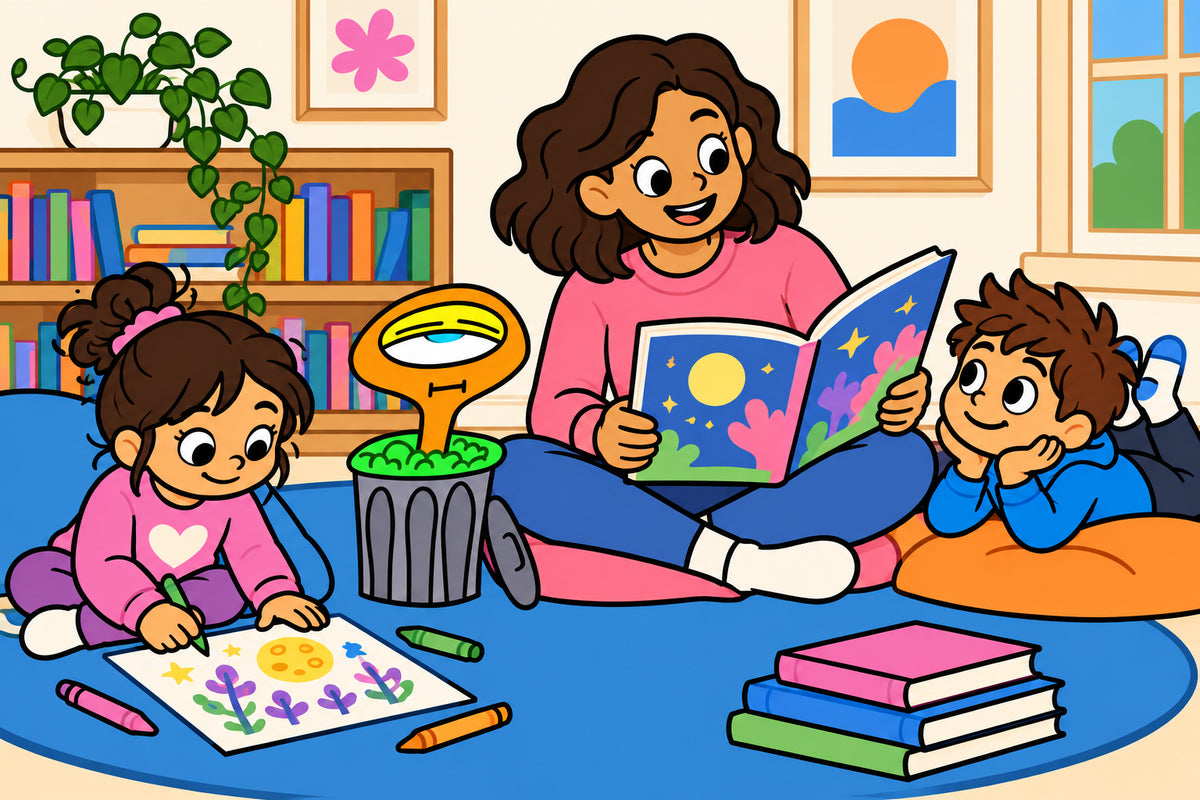
Make shared story time welcoming by letting an adult read, offering a choice of books and giving children ways to respond through talking, pictures or play. A child can take part in a story while still finding the printed words difficult.
The dragon has lost a shoe. Your child has a theory about where it went. Then someone says, “Your turn to read,” and suddenly the book feels less inviting.
If that sounds familiar, try making one reading session a time to enjoy the story together, with the adult handling the words.
October 2026 is Dyslexia Awareness Month, as highlighted in the International Dyslexia Association North Carolina branch’s awareness calendar. It is a useful moment to ask whether our reading routines leave room for children who need something different.
Does my child have to read aloud for story time to count?
No. You can read to your child and share the conversation about what happens.
The International Dyslexia Association’s family guide explains that adults reading aloud can support language comprehension while children receive instruction in identifying written words. Enjoying a story and learning to read its words can happen alongside each other.
Before opening the book, try: “I can read today. You can listen, interrupt with an idea or tell me when you want to see the picture again.”
If your child wants to read a line, welcome that. If they prefer to listen, keep the invitation open.
How can I give my child a useful part in the story?
Offer a job that adds something to your time together.
Your child might choose the book, turn pages, invent a character’s voice or draw a place from the story. Ask which sounds enjoyable rather than assigning a role based on what you think they can do.
For a child who likes drawing, put a sheet of paper beside the book and say, “You can sketch the place you hear about. I wonder what you’ll put there.”
Drawing a response to a story is one option discussed in the Yale Center for Dyslexia & Creativity’s guidance for families. Our drawing invitation is a simple way to try that idea, without a worksheet or a correct picture to copy.
What can we say when a word feels difficult?
Ask what kind of help the child wants in that moment.
“Would you like me to say that word, or would you like a moment?”
For this shared reading session, you can supply the word and continue. If you are doing an activity set by their teacher, follow the agreed approach to helping.
You can also notice their contribution specifically: “You spotted that the character changed her mind.” There is more to discuss than how quickly a page was read.
If reading remains difficult, speak with your child’s teacher about the support and instruction they need. A welcoming story routine belongs alongside that work.
How can Hobart join our story time?
If your child enjoys character play, invite Hobart aka Trash Schnerd to be the audience.
After a few pages, ask, “Hobart missed the beginning. What should we tell him?”
Your child might explain, point to an illustration or act out a moment. Hobart can receive a dramatic performance or a very brief update. His imaginary appointment book is flexible.
The Hobart Schnerd Plush is recommended for ages 3 and older. He can join pretend storytelling as a character companion. You can also explore the coloring pages in Schnerds for education.
At Schnerds, we make room for individuality, imagination and belonging. Giving a child a choice about how to join a story is one everyday way to put those values into practice.
What can teachers change for a group?
Explain participation choices to everyone before you begin.
“While I read, you can listen or sketch something from the story. Afterwards, you can share an idea or pass.”
Keep those options open to the whole group, so a child does not have to explain a reading difficulty to choose one. Give children time to respond and avoid assuming that the fastest answer is the most thoughtful one.
What can we try tonight?
Let your child choose a book and ask, “Would you like to listen, talk about the pictures or draw while I read?”
The American Academy of Pediatrics encourages following children’s interests and keeping shared reading enjoyable, even when you only have a few minutes.
Read a little. Follow one interesting thought. Leave a bookmark if everyone is ready to stop.
And if your child has solved the mystery of the dragon’s missing shoe, make time to hear the explanation. That idea belongs beside the book, too.


